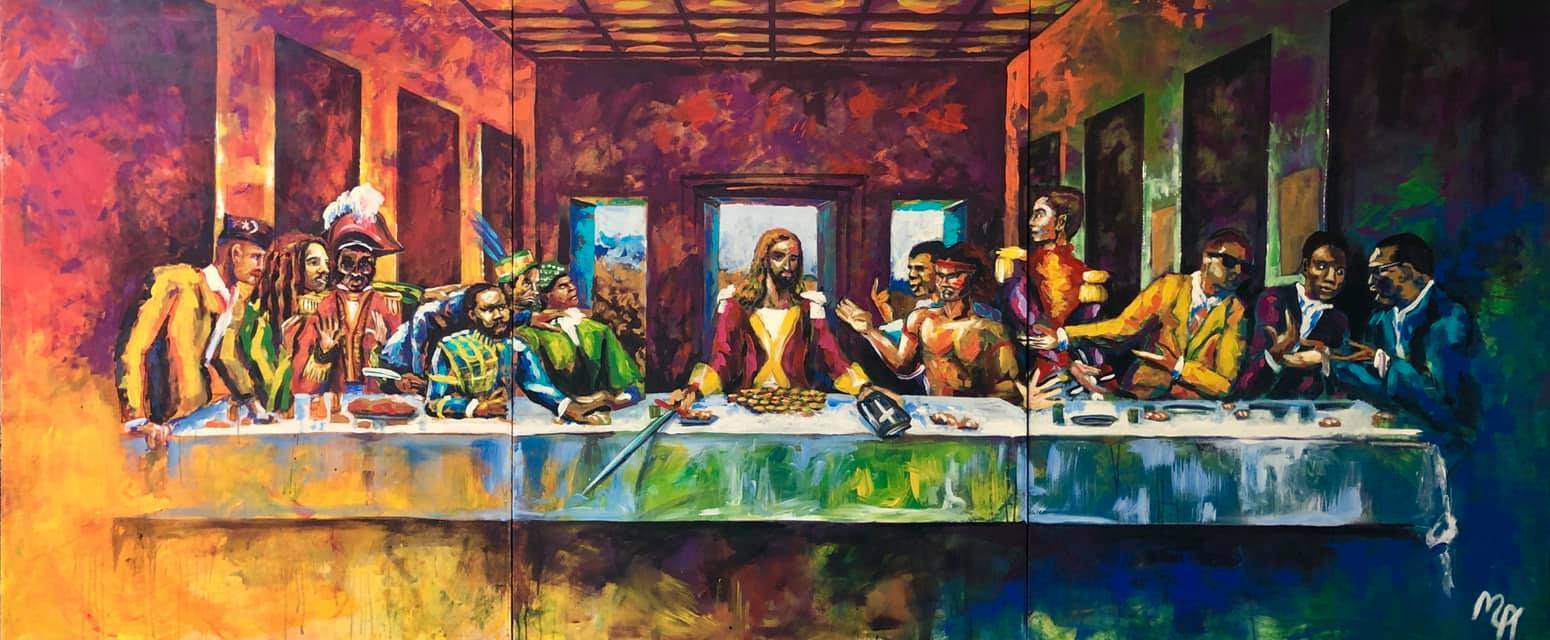
The Last Colonial Meal
Sir Calvert Jones
Acrylic on canvas
Triptych · 126 × 54 in (width × height)
Across space and time
Sir Calvert Jones reimagines Leonardo da Vinci’s The Last Supper as a vivid conversation across time about freedom, self-determination and the legacies of colonialism.
Twelve historical and contemporary figures surround a central allegorical character. Through colour, symbolism and deliberate juxtapositions, the work invites reflection on power, liberation and a shared human future.
The artwork done in the personal painting style coined by the Artist - Calvert Jones - as Tropical Realism, a unique blend of impressionism, fauvism, pop art and expressionism, with bold colors strewn with loose and flowing brush strokes across a cosmopolitan-colored backdrop of the range of visible light.
The painting intriguingly draws the observer into focusing on the central character in 18th Century British Military Regalia, who though not Jesus, is deliberate in the contradictory presentation of Jesus’s widely accepted likeness – a pictorial challenge to our narrative fallacy. Instead, this figure represents the depiction of the three pillars through which Colonialism and Imperialism have presented their faces to Western Man, both past and present. These pillars are in the form of War, symbolized by the sword, Economic pillaging symbolized by the thirty pieces of gold and religious mollification, symbolized by the Bible.
The central character is surrounded by twelve (12) past and present proponents who, while real, are also allegorical in their representations with their placements mirroring the positions of all characters in the Da Vinci Masterpiece “The Last Supper”.
The triptych’s three-panel structure and the numerical relationships within its dimensions form part of the artist’s exploration of the numbers 3, 6 and 9.
For the artist, these numerical relationships offer a philosophical framework for considering consciousness, connection and humanity.
Within the numerological interpretation used by the artist, the number 9 evokes compassion, tolerance, philanthropy and concern for humanity. This symbolism is presented as part of the work’s conceptual language.
The painting, like the unique intrigue surrounding its dimensions, is both visually captivating as it is conversational and conceptual. It is limited in size yet unlimited in the scope of understanding, tangible in its three part yet intangible in the third eye of understanding, physical in appearance yet psychological and spiritual in meaning and value, historical in past references yet charting a message for the future.
The following readings reflect the artist’s intentions for the figures, listed from left to right.
1. Elijah Muhammad based on his proliferation of the message of Black Unity, financial independence, self-help and a strict code of moral conduct among the Black Community rather than confrontation and forced integration between the races.
2. Robert Nesta Marley, “Bob Marley” was chosen for several reasons.
I. As a symbol for the role of the creative industry in influencing a generation and how it can contribute to the message of hope, unity, peace and love.
II. Humble beginnings or being considered part of the rejected class of society don’t define your limitations and vision for yourself;
III. His role as a Rastafari, who promoted conscious living and the usefulness of the marijuana for both physical healing and spirituality. This is very important from the context that many black and colored males have been disproportionately incarcerated (especially in North America) for drug offenses affecting the family structure and economic balance in their communities, yet today, this same plant is being decriminalized based on new research in the several medicinal benefits it presents.
3. Jean -Jacques Dessalines was an instrumental representative for the significance of revolutionary pursuits, constitutional reform and liberation in the process of self-determination, freedom and independence.
4. Prince Klaas is present and he’s holding a knife in his hidden hand ready to consider aggression as a possible solution to conflict. There is a time for everything and as his legacy is written, while his plans were elaborate and commendable, it wasn’t successful because timing is also key.
5. Marcus Garvey popularly known as “Black Moses” was a key figure in Western History and started one of the largest organized mass movements in black history and was a progenitor of the modern "black is beautiful" ideal of racial pride and the psychological restoration.
6. Harriet Tubman represents liberation from both physical and mental bondage, as well as the pursuit of women’s rights. Her placement draws on the artist’s interpretation of the figure beside Jesus in Leonardo’s composition; the reference to Mary Magdalene belongs to this artistic reading.
7. Joseph Chatoyer was used as a symbol of National Pride, personal excellence, leadership, diplomacy and vision and the historical representative of the indigenous Peoples of the Western World. His legacy in forcing the British to sign a treaty in 1773 with St. Vincent and the Grenadines is a stark reminder of the legacy of the indigenous and colored People to organize and negotiate terms of agreement.
8. Booker Taliaferro Washington was important among these characters as he represented a voice for the oppressed. Being part of the last generation in the United States born into slavery, he’s considered the forerunner to most civil rights movements and his lifelong achievements would be considered extraordinary as he rose to become a progressive voice for entrepreneurship in the Black Community
9. Simón José Antonio de la Santísima Trinidad Bolívar Palacios Ponte y Blanco, generally known as Simón Bolívar was included because of the role enlightenment played in his quest to liberate Venezuela, Bolivia, Colombia, Ecuador, Peru, and Panama. His role highlights the important of consciousness, psychological healing, knowledge and civic virtue among People. His position and readiness to draw his sword as displayed in the painting, calls to the forefront the decisiveness of the action that is needed.
10. The Hon. Dr. Eric Eustace Williams’ inclusion was symbolic of how the usage of pragmatic socialism, could be used as a possible tool for community advancement, improved education, and economic development through the cautious attraction of foreign investment capital. The policy was fruitful in making Trinidad and Tobago the wealthiest Commonwealth Caribbean nation and is a modern demonstration of how a Country can defy challenges and chart its own success.
11.Paul Bogle represents the necessity of defying the status quo. Whether it be for equality and justice against any system of oppression, particularly the systems of classism, racism and elitism that exists throughout the Western World.
12. Louis Farrakhan is included in the artist’s account as a reference to the Million Man March, family structure and spiritual renewal.
This painting, through its baiting of narratives, biases, emotions and controversy is in actuality a harbinger of hope and unity. Hope that we can all have our conversations presented at the table, devoid of pretenses, biases and discrimination to chart a new way forward so we can all live and thrive together.
This painting is a living, riveting and ever evolving conversational piece that goes beyond what is represented to questions on what isn’t. A facilitator of the tough questions and discussions and negotiations we need to have. As with the table – it is single just like our planet is single, we may be many, but we are all connected.
Discuss this work
Contact the studio about the artwork and your interest.
Framing, delivery and care
Tell us where the work will be displayed and its delivery destination. Framing, packing, freight, installation and any applicable taxes are confirmed in your quotation. Request care guidance suited to the medium and display environment.
More by Sir Calvert Jones
Select an artwork below to view it in detail, or explore the artist’s Masterpieces and Icons collections in the gallery.